
Note
Go to the end to download the full example code.
DTI colours in the viewer#
The principal eigenvector of a DTI fit, as lar dti writes it (<prefix>_pe.nii.gz,
a 4D image with the x, y and z of each voxel’s main direction), can be shown as a
direction-encoded colour map: red, green and blue for the size of the direction’s x,
y and z, so red runs left to right, green front to back and blue up and down. The
colours can be modulated by another image on the same grid, usually the FA, which
darkens the voxels with no clear direction.
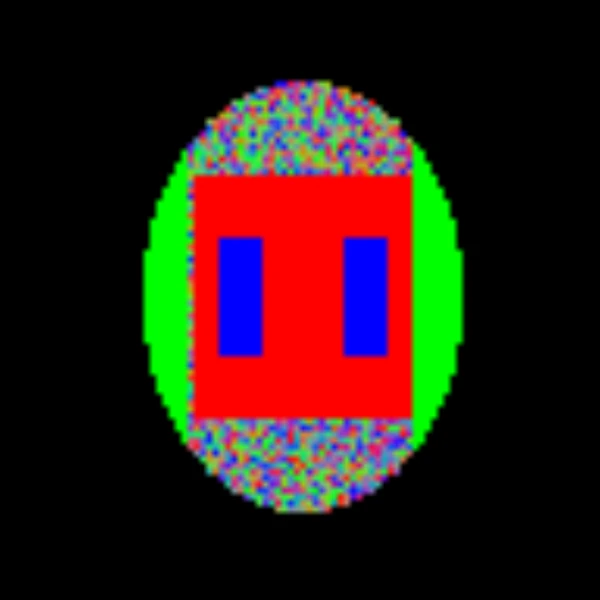
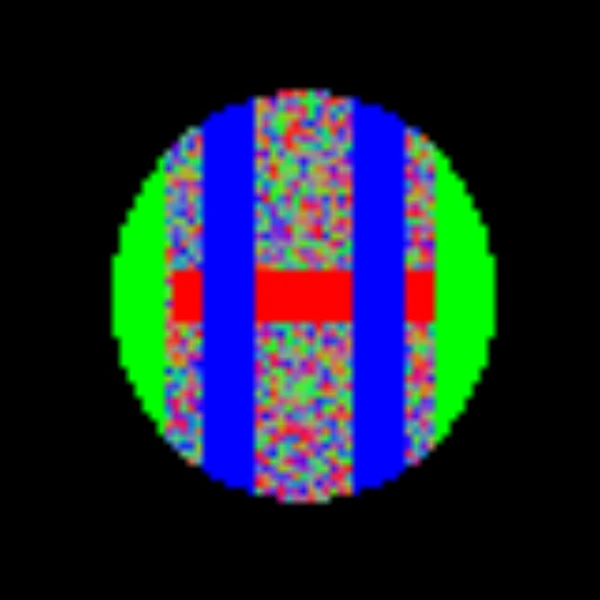
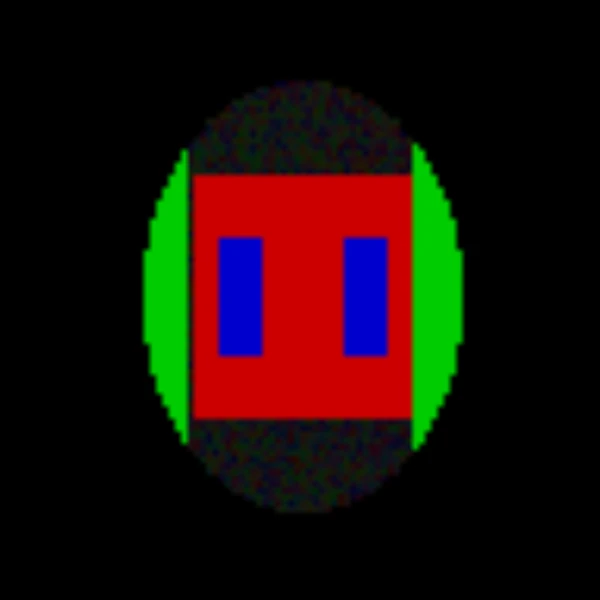
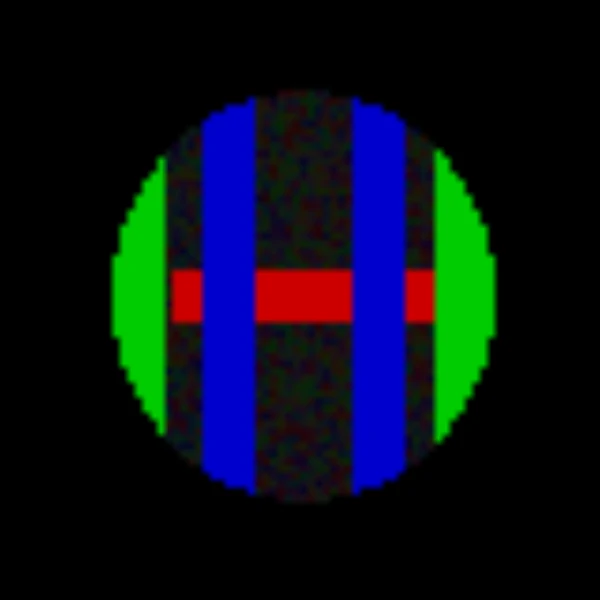
This example builds a synthetic head with a field of directions and an FA map over it, and saves screenshots of the axial and coronal views with the plain colours and with the FA modulating them.
A synthetic head#
A 2 mm image of an ellipsoid, centred at the world origin (world coordinates are in mm, RAS+).
shape = (80, 96, 80)
affine = np.diag([2.0, 2.0, 2.0, 1.0])
affine[:3, 3] = -np.array(shape)  # half the extent in mm: the centre at 0
i, j, k = np.indices(shape, dtype=np.float32)
x, y, z = (2 * i / shape[0] - 1, 2 * j / shape[1] - 1, 2 * k / shape[2] - 1)
r = np.sqrt((x / 0.8) ** 2 + (y / 0.9) ** 2 + (z / 0.85) ** 2)
brain = r < 0.8
Directions and FA#
Three bundles over a background of random directions: a band across the middle
running left to right (like the corpus callosum), two lateral bundles running
front to back (like the cingulum or the superior longitudinal fasciculus) and two
columns running up and down (like the corticospinal tracts). The FA is high in
the bundles and low elsewhere. Each direction is a unit vector, as lar dti
writes it; its sign does not matter.
rng = np.random.default_rng(0)
directions = rng.standard_normal((*shape, 3)).astype(np.float32)
fa = np.full(shape, 0.15, np.float32)
bundles = {  # in this order, so the columns cross the band
    (0.0, 1.0, 0.0): brain & (np.abs(x) > 0.45),  # front to back
    (1.0, 0.0, 0.0): brain & (np.abs(z) < 0.1) & (np.abs(y) < 0.4) & (np.abs(x) < 0.45),
    (0.0, 0.0, 1.0): brain & (np.abs(np.abs(x) - 0.25) < 0.08) & (np.abs(y) < 0.2),
}
for direction, where in bundles.items():
    directions[where] = direction
    fa[where] = 0.8
directions /= np.linalg.norm(directions, axis=-1, keepdims=True)
directions[~brain] = 0
fa[~brain] = 0
pe = Volume(directions, affine)
fa_map = Volume(fa, affine)
The viewer and its items#
The eigenvector is a volume and the FA an overlay, hidden: it is only used to modulate the colours. DTI colours are an option of the image, for a 4D image with exactly 3 volumes.
viewer = Viewer()
# The screenshots hide the crosshair and the text, so they show only the data.
viewer.toggle_crosshair()
viewer.toggle_overlay()
vectors = viewer.add(pe, Category.VOLUMES, name="pe")
fa_item = viewer.add(fa_map, Category.OVERLAYS, name="fa")
viewer.set(fa_item.id, OptionName.VISIBLE, False)
viewer.set(vectors.id, OptionName.DTI, True)
The plain colours#
Each channel is the size of the direction’s component, clipped to [0, 1], so a unit vector is at full brightness: the background’s random directions are as bright as the bundles.
viewer.screenshot(ViewKind.AXIAL, "viewer_dti_axial.png", size=(600, 600))
viewer.screenshot(ViewKind.CORONAL, "viewer_dti_coronal.png", size=(600, 600))
Modulated by FA#
Any 3D volume or overlay on the same grid can modulate the colours; its values,
clipped to [0, 1], multiply them. With the FA, the bundles stand out and the
background fades. An eigenvector already multiplied by the FA (as mrcalc pe fa
-mult makes it) gives the same picture with no modulation.
viewer.set(vectors.id, OptionName.MODULATE, fa_item.id)
viewer.screenshot(ViewKind.AXIAL, "viewer_dti_fa_axial.png", size=(600, 600))
viewer.screenshot(ViewKind.CORONAL, "viewer_dti_fa_coronal.png", size=(600, 600))
print(f"{int(brain.sum())} voxels in the brain")
100777 voxels in the brain