Note
Go to the end to download the full example code.
Writing a tractogram batch by batch#
A whole-brain tractography run can produce millions of streamlines, far more than
fit in memory at once. open_tractogram_writer writes a TCK or TRK file in pieces:
each batch of streamlines is appended as soon as it exists, and only that batch is
kept in memory. The streamline count goes into the header when the file is finished.
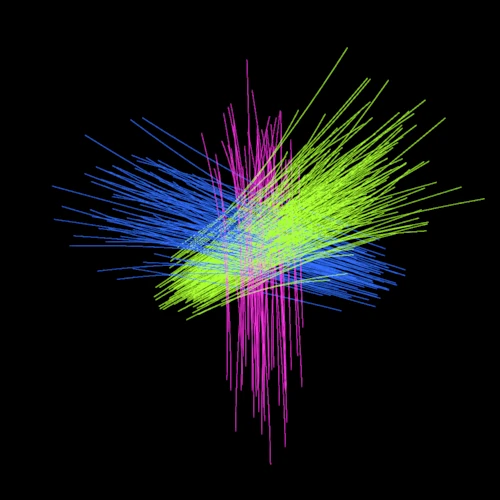
This example writes a tractogram in three batches, reads it back, checks that the file is the same as writing all the streamlines at once, and shows the three batches in the viewer.
import tempfile
from pathlib import Path

import numpy as np

from larmor.io import load_tractogram, open_tractogram_writer, save_tractogram
from larmor.types import Tractogram
from larmor.viewer import (
    CameraPreset,
    Category,
    Colouring,
    OptionName,
    Viewer,
    ViewKind,
)
Batches of streamlines#
Each batch is a Tractogram: the points of its streamlines one after the other, and
the offsets where each streamline starts. Here, three batches of gently curving
streamlines, each batch a bundle of its own, as the seeds of one batch would give.
rng = np.random.default_rng(0)


def random_batch(num_streamlines: int, direction: np.ndarray) -> Tractogram:
    """Streamlines of 1 mm steps along a direction, each bending its own way."""
    lines = []
    for _ in range(num_streamlines):
        n = int(rng.integers(30, 60))
        t = np.arange(n, dtype=np.float32)[:, None]
        start = rng.normal(0.0, 3.0, 3) - direction * n / 2
        bend = rng.normal(0.0, 0.0015, 3)
        lines.append((start + t * direction + t**2 * bend).astype(np.float32))
    offsets = np.concatenate([[0], np.cumsum([len(line) for line in lines])])
    return Tractogram(np.concatenate(lines), offsets)


x, y, z = np.eye(3)
batches = [random_batch(n, d) for n, d in ((100, x), (250, y), (50, z))]
Writing in batches#
The writer is a context manager: leaving the block finishes the file. If the block raises, as an interrupted run does, the file keeps a count that marks it as incomplete, and reading it gives a warning.
folder = Path(tempfile.mkdtemp())
with open_tractogram_writer(folder / "batched.tck") as writer:
    for batch in batches:
        writer.write(batch)

tractogram = load_tractogram(folder / "batched.tck")
print(f"streamlines written: {tractogram.num_streamlines}")
assert tractogram.num_streamlines == 400
streamlines written: 400
The same file as writing everything at once#
The streamlines of all batches, joined, written with save_tractogram.
points = np.concatenate([b.points for b in batches])
lengths = np.concatenate([np.diff(b.offsets) for b in batches])
whole = Tractogram(points, np.concatenate([[0], np.cumsum(lengths)]))
save_tractogram(whole, folder / "whole.tck")

same = (folder / "batched.tck").read_bytes() == (folder / "whole.tck").read_bytes()
print(f"identical files: {same}")
assert same
identical files: True
The batches in the viewer#
A tractogram can be indexed with a slice, here to take each batch back out of the file, and the viewer gives each tractogram its own colour.
viewer = Viewer()
start = 0
for n, batch in enumerate(batches):
    end = start + batch.num_streamlines
    viewer.add(tractogram[start:end], Category.TRACTOGRAMS, name=f"batch {n + 1}")
    start = end
viewer.set(Category.TRACTOGRAMS, OptionName.COLOURING, Colouring.PER_TRACTOGRAM)
viewer.set_camera(ViewKind.THREE_D, CameraPreset.CORONAL)
viewer.rotate_camera(35.0, 25.0)
viewer.zoom(ViewKind.THREE_D, 0.7)
viewer.screenshot(ViewKind.THREE_D, "batches_3d.png", size=(500, 500), overlay=False)