Note
Go to the end to download the full example code.
Track density images#
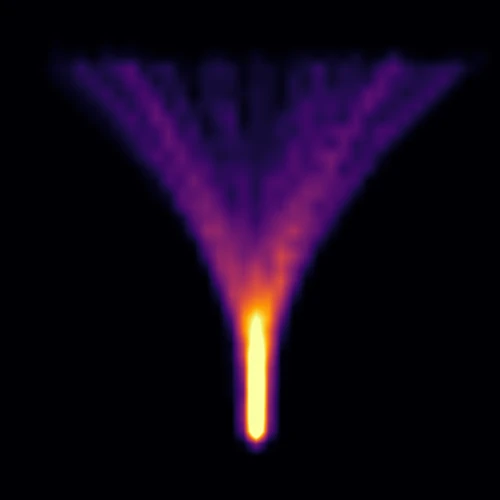
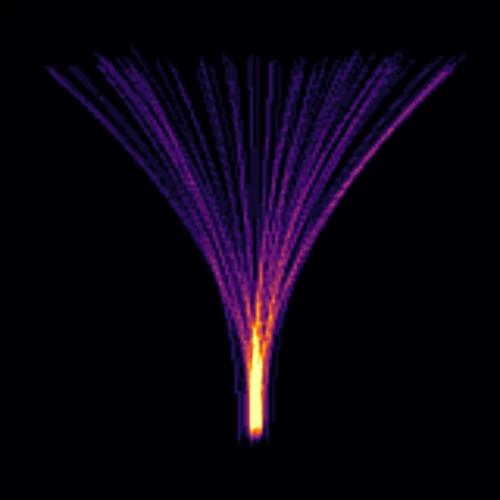
A track density image counts, in each voxel of a grid, the streamlines that pass through it. On the grid of the diffusion data it shows where tractography went; on a finer grid it gives the super-resolution maps of track-density imaging (Calamante et al. 2010), because each streamline is followed more finely than the voxels it was tracked in.
This example builds a synthetic bundle, maps it on a 2 mm grid and on a 0.5 mm one,
weights the streamlines, maps their endpoints, and shows the maps in the viewer.
lar tract-density does the same from files.
import numpy as np

from larmor.tractography import density_grid, track_density
from larmor.types import Grid, Tractogram
from larmor.viewer import Category, Colormap, OptionName, Viewer, ViewKind
A synthetic bundle#
200 streamlines with 1 mm steps, fanning out from a narrow stem near the origin along +y, each bending sideways by its own amount. The points are in world coordinates (mm).
rng = np.random.default_rng(1)
steps = np.arange(60, dtype=np.float32)
streamlines = []
for _ in range(200):
    start = rng.normal(0.0, 1.0, 3).astype(np.float32)
    bend = rng.uniform(-0.01, 0.01)
    x = start[0] + bend * steps**2
    streamlines.append(np.stack([x, start[1] + steps, start[2] + 0 * steps], axis=1))
offsets = np.concatenate([[0], np.cumsum([len(s) for s in streamlines])])
bundle = Tractogram(np.concatenate(streamlines), offsets)
print(f"{bundle.num_streamlines} streamlines, {bundle.num_points} points")
200 streamlines, 12000 points
On the diffusion grid#
A 2 mm grid around the bundle. Each streamline adds 1 to every voxel it passes through, once, however many of its points fall in the voxel. Before the points are mapped, the streamlines are upsampled along a smooth curve, so that no voxel between two points is missed.
affine = np.diag([2.0, 2.0, 2.0, 1.0])
affine[:3, 3] = [-40.0, -10.0, -10.0]
grid = Grid((40, 40, 10), affine)
density = track_density(bundle, grid)
print(
    f"2 mm: {np.count_nonzero(density.data)} voxels reached, at most "
    f"{density.data.max()} streamlines in one"
)
assert density.data.max() <= bundle.num_streamlines
2 mm: 1247 voxels reached, at most 103 streamlines in one
Super-resolution#
density_grid makes a grid of 0.5 mm voxels over the same field of view. The
fan’s stem stays dense while its spread-out end thins to single streamlines.
fine = track_density(bundle, density_grid(grid, 0.5))
print(f"0.5 mm: grid {fine.data.shape}, {np.count_nonzero(fine.data)} voxels reached")
0.5 mm: grid (160, 160, 40), 18900 voxels reached
Weights and endpoints#
With per-streamline weights (such as SIFT2’s), each streamline adds its weight instead of 1. The endpoint density counts only where streamlines start and end.
weights = rng.uniform(0.5, 1.5, bundle.num_streamlines)
weighted = track_density(bundle, grid, weights=weights)
ends = track_density(bundle, grid, ends_only=True)
print(f"total weight in the densest voxel: {weighted.data.max():.1f}")
print(f"endpoints counted: {ends.data.sum()}")
assert ends.data.sum() == 2 * bundle.num_streamlines
total weight in the densest voxel: 106.3
endpoints counted: 400
In the viewer#
The result is a Volume: save it with save_volume, or show it in the viewer,
here the 2 mm and the 0.5 mm maps on the axial slice through the bundle, in the
same colormap, which saturates at half of each map’s maximum so the thin
branches show. The screenshots hide the crosshair and the text.
for name, image in (("tdi_2mm.png", density), ("tdi_05mm.png", fine)):
    viewer = Viewer()
    item = viewer.add(image, Category.VOLUMES, name="density")
    viewer.set(item.id, OptionName.COLORMAP, Colormap.INFERNO)
    viewer.set(item.id, OptionName.MAXIMUM, float(image.data.max()) / 2)
    viewer.move_cursor((0.0, 20.0, 0.0))
    viewer.toggle_crosshair()
    viewer.screenshot(ViewKind.AXIAL, name, size=(500, 500), overlay=False)